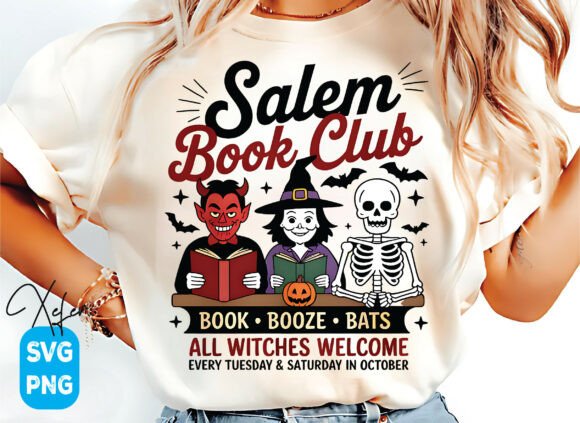
Salem Book Club PNG: A Retro Halloween Embroidery Design Review
Real-Life Use Scenarios
- Tote bag designs: The high-resolution PNG works beautifully as an applique design. When stitched onto a canvas tote, the bat wings and candle outlines remain crisp, even after multiple washes.
- Sweatshirt embroidery: On a medium-weight sweatshirt, the satin stitch areas (like the book title) have a smooth finish. The fill stitches don’t pill easily, making it a good choice for cozy, frequently worn items.
- Baby clothes and nursery decor: While the Halloween theme may be too spooky for some little ones, the design could work as a subtle fall-themed accessory. Just be mindful of stitch density in delicate fabrics — more stabilization is needed.
- Embroidered patches: This design translates well into patch form, especially when using a light-colored background fabric. The contrast between the dark lines and the backing really helps the design pop.
- Cap and hat embroidery: Curved surfaces can challenge any design, but Salem Book Club PNG handles it with grace if you adjust the placement and hoop carefully.
Design Performance and Practical Considerations
Stitch clarity is one of the strengths here. The lines are well-defined, and the overall shape maintains its integrity. But when working with small hoop sizes, you’ll need to scale it down carefully. Any reduction below 4 inches might cause the fine details to lose definition, especially in the corners and around the book spine.
Also, keep in mind that textured or stretchy fabrics can distort the image slightly. I recommend testing the design on scrap material first to see how the stitch density interacts with the fabric texture. If you plan to use it on something like a knit t-shirt, a bit more stabilizer will help maintain sharp lines and prevent distortion.
The thread colors used in my test were black and deep red, which worked well against lighter backgrounds. For darker fabric, you might want to consider using white or cream threads to ensure visibility. Always do a black and white mockup to visualize how the design will look under low-light conditions or when printed digitally for previews.
Where to Use It Carefully
- Thin or stretchy fabric: The design’s detail-heavy areas might pucker or distort unless properly stabilized.
- Dense stitch areas: The book outline and text require careful attention to stitch spacing and tension. Too much density can lead to stiffness or breakage.
- Curved surfaces: Caps or hats need precise alignment and possibly a smaller version of the design to avoid stretching.
- Products needing frequent washing: Make sure your stabilizer and thread choices can handle repeated laundering without losing quality.
Testing Tips from the Pros
- Test on scrap fabric first: Especially if you're using a new type of fabric or adjusting the design size.
- Check thread color contrast: Darker thread on dark fabric won’t show. Always compare on similar materials.
- Review stitch density: Adjust fill and running stitches depending on the fabric weight and desired outcome.
- Confirm hoop size: Some parts of the design may require a larger hoop than others to avoid misalignment.
- Inspect small details: The corners and inner elements can sometimes get lost if not stitched with precision.
- Use proper stabilizer: Depending on the fabric, you might need more support for the design to hold up.